
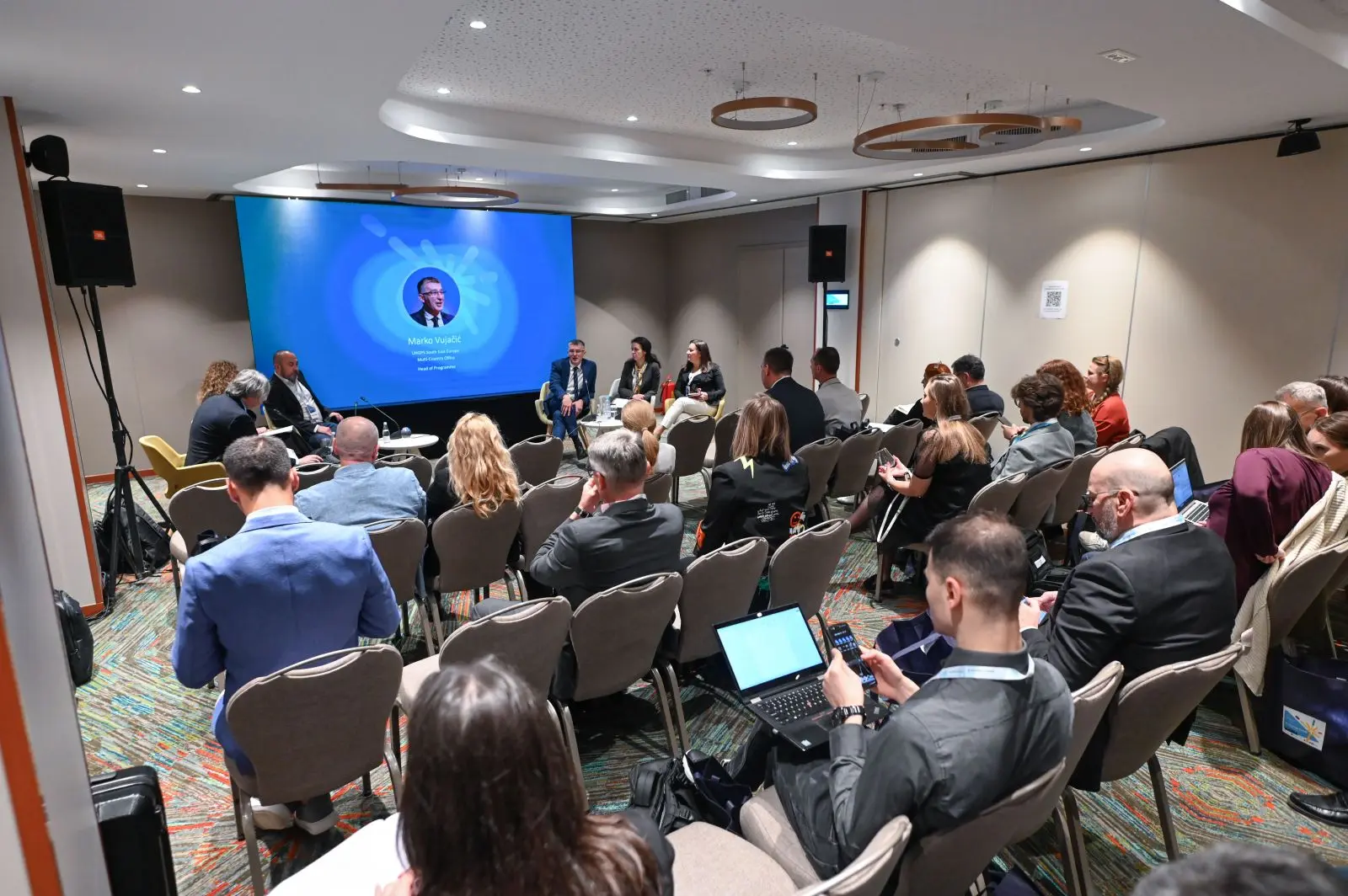
As part of the multi-day Forum of the European Union Strategy for the Adriatic and Ionian Region (EUSAIR), which opened in Skopje on Monday, Vladanka Raković, representative of the Ministry of European Integration, participated in the panel discussion “Tools for EUSAIR Integration: Strengthening Territorial Development and Cross-Border Cooperation Across the Macro-Region”. At the panel, organised by UNOPS together with the European Commission’s Directorate-General for Regional and Urban Policy (DG REGIO), examples of good practice in Serbia were presented, ranging from the development of local socio-economic perspectives to integrated territorial development, as potential examples of development models across the macro-regions covered by EUSAIR.
In addition to the Ministry representative, the discussion also included Marko Vujačić, Head of Programme at UNOPS for Southeast Europe; Viktoro Veljović, UNOPS Senior Officer for Capacity Building for Integrated Territorial Development within the EU PRO Plus and EU INTEGRA programmes; Tatjana Zdravković, Executive Director for Urban Planning and Construction in the City of Leskovac; and Radica Kočeva, expert in EU financing and Chapter 22. The discussion was moderated by Gilles Kittel, Team Leader for Southeast Europe, Competence Centre for Macro-Regions and European Territorial Cooperation at DG REGIO.
The European Union Strategy for the Adriatic and Ionian Region (ЕУСАИР) is a macro-regional framework bringing together ten countries with the aim of strengthening cooperation, promoting sustainable development, and supporting European integration through joint action in key policy areas. Through a multi-stakeholder approach, ЕУСАИР plays a central role in fostering economic, social, and territorial cohesion, as well as supporting the stability and European integration of the macro-region. These objectives are implemented through five thematic pillars covering sustainable blue economy, connecting the region (transport and energy), environmental quality, sustainable tourism, and social cohesion.


