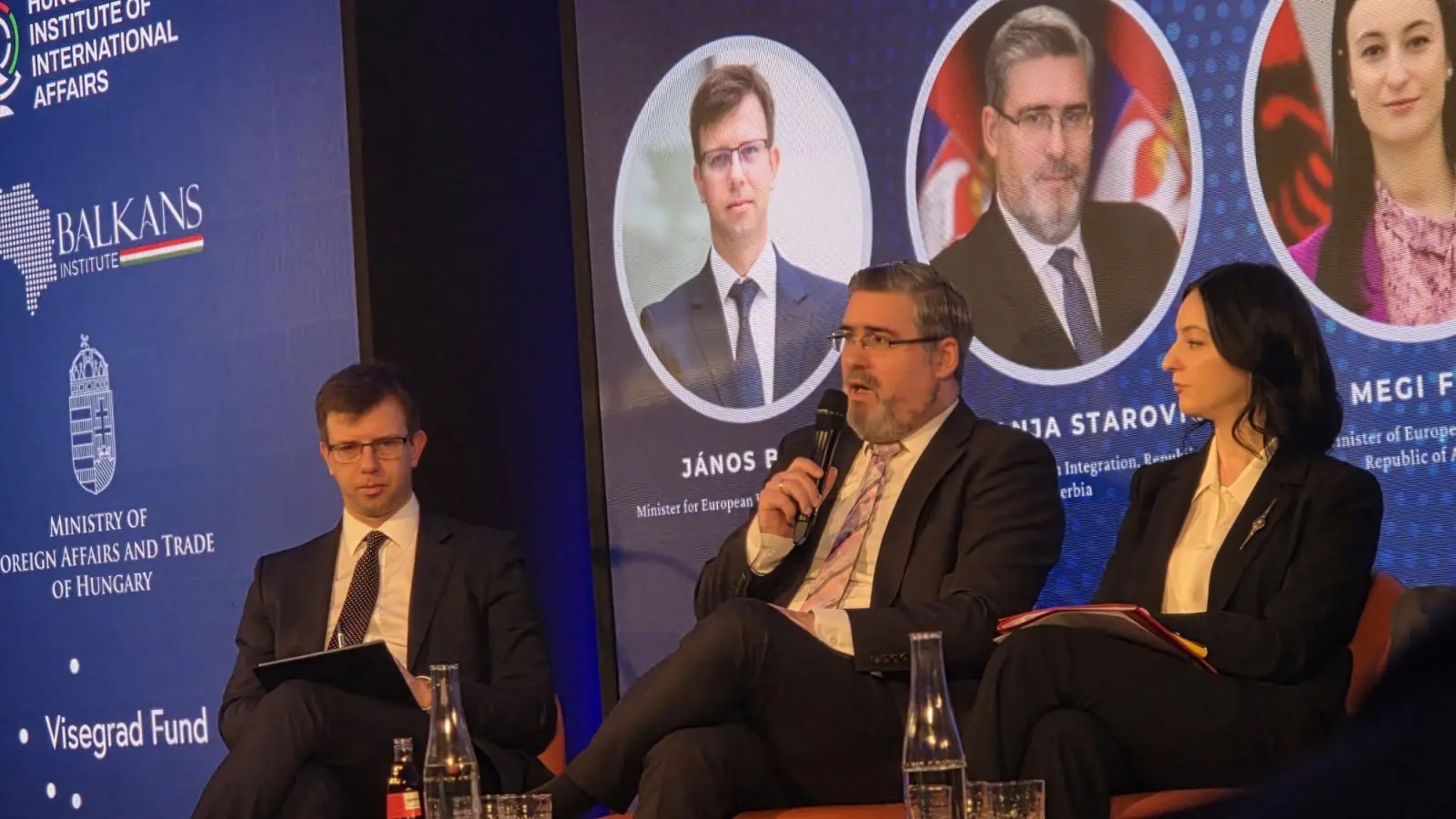
Minister of European Integration of Serbia Nemanja Starović, stated today in Budapest that the European Union enlargement represented a key test of the credibility of the EU’s strategic commitments, emphasising that the Western Balkans region was already deeply integrated into the European Economic Area, but that political integration had not yet been completed.
At the Tenth Annual Balkan Forum in Budapest, which is being held from 9 to11 March in the Hungarian capital, Minister Starović participated today in the first panel titled “From Words to Deeds: Enlargement and the Western Balkans”, together with János Bóka, Minister for European Union Affairs of Hungary; Megi Fino, Deputy Minister for Europe and Foreign Affairs of the Republic of Albania; and Predrag Zenović, Chief Negotiator of Montenegro with the European Union.
Starović emphasised that the Western Balkans was geographically surrounded by EU Member States and that the region’s economies were already strongly connected with the European market. As he noted, in the case of Serbia, almost two-thirds of trade was conducted with the EU, which was also the largest investor in the Serbian economy.
Minister Starović pointed out that reforms in Serbia were real and continuous, and that the EU accession process represented the main framework for internal changes in the country – from judicial reform and strengthening institutions to improving the business environment and aligning economic policies with European regulations and standards.
Speaking about concrete steps that would demonstrate stronger commitment to enlargement, the Minister mentioned the gradual integration of the region into the European Single Market, as well as the initiative of the European Commission to begin negotiations on the “Roam Like at Home” initiative, that is, on extending the European Union’s roaming regime to the Western Balkans.
“For the citizens of the region, this does not only mean lower communication costs but also represents a strong symbol of real integration,” Starović said.
He also pointed to the importance of the potential inclusion of the region in the Schengen area, noting that the Western Balkans nowadays functioned in a certain way as an “internal external border” of the EU, because it was geographically within the European space, but still separated by borders that slowed down trade and the movement of people.
According to him, some Member States, including Hungary, often emphasised that enlargement was not a burden but an opportunity for the European Union, as the Western Balkans represented growing markets, important transport and energy corridors, as well as significant human capital.
Concluding his address, Starović stated that the Western Balkans belonged to the European Union – historically, economically, and politically. “The question today is not whether enlargement will happen, but whether Europe will seize the strategic moment for it to happen sooner rather than later,” Minister Nemanja Starović concluded.


