
Although there has been no opening of new negotiation chapters over the past four years, I would not agree with the assessment that Serbia’s EU integration process is frozen. Namely, we are implementing our Reform Agenda at a satisfactory pace and, accordingly, drawing funds from the EU Growth Plan for the Western Balkans.
Last year, Serbia became part of SEPA, the Single Euro Payments Area; we are developing green corridors and participating in many initiatives through which we are integrating into the European market. All of this, unfortunately, has not been valorised through the formal opening of Cluster 3 due to the opposition of certain Member States, despite the positive recommendation of the European Commission, which is the only body competent to assess whether Serbia deserves this.
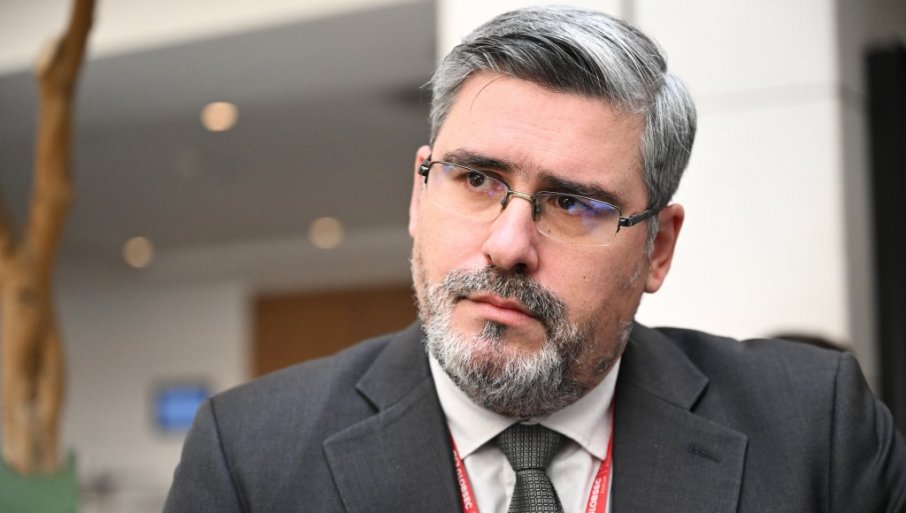
With this assessment, Nemanja Starović, Minister of European Integration, addressed the readers of “Novosti”, expressing his belief that the prevailing responsibility for the current state of relations between Serbia and the EU did not lie with official Belgrade.
Tonino Picula, the EP’s rapporteur whose delegation, according to Serbia’s authorities, was coming to Serbia uninvited, considered Belgrade to be responsible. How do you interpret his message that the political leadership must clarify whether Serbia is still strategically committed to the EU?
- I believe that this demand to clarify Serbia’s geopolitical orientation, although essentially meaningless, has in recent times become a convenient euphemism used by all those who would like Serbia to abandon its political and diplomatic struggle to defend its own territorial integrity. How meaningless it is, is evidenced not only by the fact that we made the decision to embark on the path towards EU membership as a strategic choice long ago and that this is part of the programme of every Government of Serbia, but also by everything we are doing in practical terms when it comes to reform processes, as well as by the continuous cooperation with the bodies of the European Commission.
How do you personally perceive Members of the European Parliament and representatives of Brussels in general – as partners in dialogue or as a kind of supervisors who constantly put forward new demands?
– Relations between Serbia and the EU are regulated by the Stabilisation and Association Agreement, as well as by our negotiating framework in the accession process. In that sense, there is a healthy working and partnership-based relationship with many people within the EU administration. As for Members of the European Parliament, there are a total of 720 of them, and most are not dealing with Serbia. When it comes to conditionality, I think it is already clear to everyone what the red lines are that Serbia cannot cross, which delineate our struggle to defend territorial integrity, based on the principles of military neutrality and political independence.
Hungarians have no intention of leaving
And how do you see the future of the EU, which today is facing its own crises – from Ukraine to internal divisions?
– If there is something that has marked the EU over the past twenty or so years, it is precisely crises that have followed one another. Let us just recall the crisis of adopting the European Constitution, followed by the global economic crisis, then the Greek sovereign debt crisis, the major migration crisis, the United Kingdom’s exit from the EU, the COVID-19 pandemic, all the way to the war in Ukraine and current developments. Global trends in the 21st century pose a major challenge for the EU, given that the overall economic and political conjuncture leaves the European continent on the periphery of the most important events. Nevertheless, despite all this, the EU has not fallen apart and has managed to find practical solutions. Ultimately, even the governments of Member States that are most critical of Brussels’ policies, such as Budapest or Bratislava, have no intention of leaving the EU because they recognise a clear interest in membership for their citizens.
Brussels insists on aligning our foreign policy with the EU, including sanctions against Russia. Does Serbia have a red line, or is the EU path conditioned by renouncing its own foreign policy, as well as Kosovo and Metohija?
– As I have said, Serbia’s red lines are completely clear and there can and will be no changes there, as long as the policy directed and symbolised by President Aleksandar Vučić has the majority support of our people. As for alignment with the EU’s Common Foreign and Security Policy, it is our obligation to gradually raise the level of alignment until the day we become a full EU Member State. We are adhering to this, and over the past year, we have increased that rate by around fifteen percentage points, despite the fact that we have not joined a single package of sanctions against the Russian Federation.How sustainable is the policy of “balancing” between the EU, Russia, and China in reality, and to what extent is this, rather than delays in reforms as claimed by Brussels, the main reason why we are “standing still”?
– I believe that the foreign policy Serbia has been pursuing for more than ten years is well thought out, based on firm principles and therefore predictable, and that it has passed the test of time by delivering tangible results. I have no doubt that many in certain Member States expect a change in the main course of Serbian foreign policy, but I am not at all certain that even such a change would open the way towards accelerated EU membership. Let us just look at the example of North Macedonia, where accession to NATO, the change of the country’s constitutional name, and meeting numerous other demands did not help to unblock the path towards EU membership.
If European integration remains blocked for another five or ten years, does Serbia have a clear “plan B”? What, in your view, is the alternative to EU membership?
– The EU represents a natural framework for our further development. This is a reality stemming from our history, geographical position, interconnected economic structures, and the need to ensure that the 21st century finally becomes a century of peace for our people. We must also understand that we would not have been able to achieve significant results in terms of economic development, infrastructure construction, and raising the living standard of citizens over the past decade had we not been on the path towards EU membership throughout that time. I therefore do not believe that there is a credible alternative to continuing Serbia’s integration into the EU. With full understanding of all the disappointment and even bitterness that many people rightly feel due to the hypocrisy and double standards to which we are often exposed, I believe that political decision-makers have no right to an emotional approach and must act responsibly towards the future of the state and the people.
Source: "Novosti"


