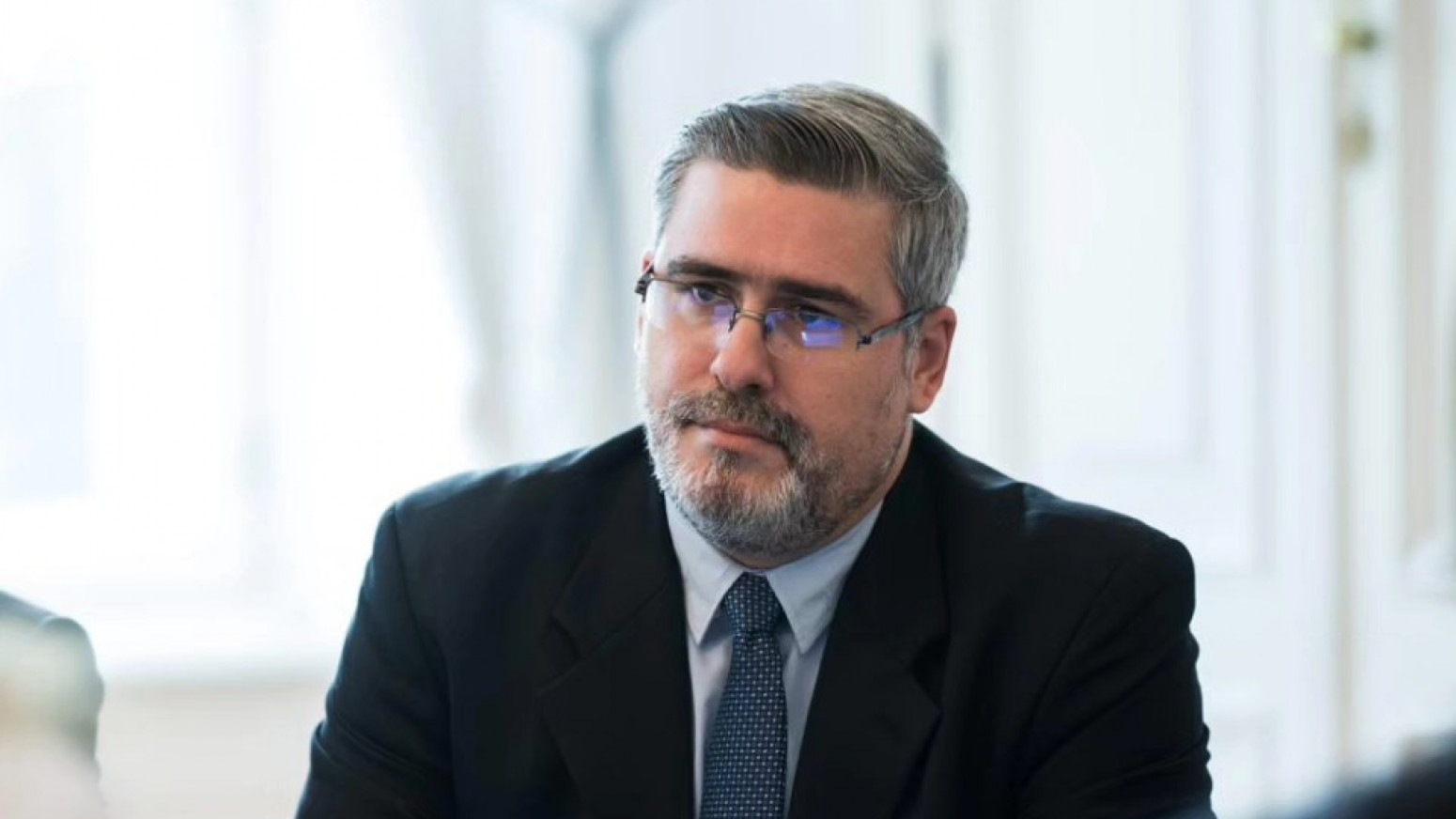
Serbia’s Minister for European Integration, Nemanja Starovic, strongly criticized the authorities in Pristina in an interview with the Austrian news agency APA over the arrest of Igor Popovic, Assistant Director of the Office for Kosovo and Metohija, stating that Albin Kurti is pursuing internal political goals at the expense of the Serbian community, and demanding Popovic’s immediate and unconditional release.
Starovic said that Popovic’s arrest violates the 2012 Brussels Agreement, which, he reminded, grants Serbian officials the right to visit Kosovo with prior notification.
“The assistant head of the Office for Kosovo and Metohija was arrested after attending a commemoration of the massacre of Kosovo Serbs and now faces a prison sentence of up to eight years. Belgrade demands his immediate and unconditional release,” Starovic told APA.
He accused Kosovo’s caretaker Prime Minister Albin Kurti of using the Serbian community as a tool for domestic political purposes.
“After losing his majority in the recent elections, he is only serving in a technical mandate and is unable to deliver on campaign promises related to the economy or anti-corruption. The only thing he can offer his voters is the repression of the Serbian community in Kosovo,” the Serbian minister said.
Nonetheless, Belgrade remains willing to engage in dialogue with Pristina, he added.
Starovic stated that Serbia is prepared to make “very difficult compromises” with Pristina because Belgrade seeks “full normalization” of relations.
“But it must not be a zero-sum game where one side loses everything and the other gains everything. There has to be compromise,” he emphasized.
APA notes that Kosovo unilaterally declared independence in 2008, recognized by 22 out of 27 EU member states, while Belgrade still considers it part of its territory, particularly emphasizing its commitment to the Serb-majority north.
Asked how EU accession would be possible for both Serbia and Kosovo given the unresolved status issue, Starovic responded that this poses a major challenge of which Belgrade is fully aware.
“But we are also aware that the European Union has always implemented practical and creative solutions,” he said, pointing to the example of Cyprus, which joined the EU in 2004 despite the unresolved conflict over its Turkish-occupied north, as well as to Ukraine.
He also reiterated Serbia’s interest in EU accession and insisted on the swift opening of further clusters in the negotiation process.
He noted that Serbia aims to adopt key reforms in the fields of elections and media by the end of the month and hopes that Cluster 3 could be opened in September.
“If not in September, then certainly during the Danish Presidency,” said Starovic, noting that the European Commission recommended the opening of this cluster more than three and a half years ago.
Given the difficult negotiation process, Starovic advocated for reducing the possibility of national vetoes in this area.
“There are about 100 decisions in this process that must be made unanimously. If you multiply that by 27, you have 2,700 potential political obstacles,” he explained.
He therefore proposed that unanimity should be required only at the end of negotiation phases, not at the opening stages.
He does not see the moderate public support for EU membership “as a significant obstacle on the path to the EU.”
He recalled that in Croatia, one year before joining the EU, support stood at only 37%, while in Serbia it is currently 46%.
Starovic also sought to dispel doubts regarding Serbia’s stance on Ukraine.
“If we are being criticized for not doing enough for Ukraine, my answer is simple: Let the Ukrainians speak for themselves,” he said, pointing to the assistance Belgrade had provided to Kyiv.
He added that Serbia does not support EU sanctions against Russia because they “would have no impact on Moscow, but would severely harm the Serbian economy,” and that as a non-EU member, Serbia lacks the safety net that EU membership provides.
In that regard, he drew a comparison to the pandemic, during which Croatia received €22 billion from EU funds, while Serbia received “almost nothing”—specifically, €165 million.
Nevertheless, he said, Serbia is ready to fully align with EU sanctions “when EU membership is within reach”—that is, only a few months before accession.
Belgrade also “clearly and unequivocally condemned the Russian invasion of Ukraine from day one,” he recalled.
Serbia, he added, supports Ukraine’s EU membership.
He also expressed satisfaction that Ukraine has reinvigorated the enlargement process itself.
“Now it’s up to us in the Western Balkans to become part of this momentum,” he emphasized.
Starovic cited the recent inclusion of Ukraine in the EU Roaming Regulation—after years of unsuccessful attempts by Western Balkan countries—as an example.
“Once it was granted to Ukraine, there was no more argument to deny it to us,” he noted, adding that the Regulation, which will come into force in early 2026, represents “the greatest achievement since the liberalization of the visa regime with the Schengen area.”
“That was in 2009—16 years ago,” he recalled.
On the issue of Bosnia and Herzegovina, Starovic reaffirmed Belgrade’s commitment to the country’s territorial integrity but urged High Representative Christian Schmidt to exercise restraint.
He also deemed the entry bans imposed by Germany and Austria on President of The Republic of Srpska Milorad Dodik as counterproductive.
“This is not something that can yield tangible results,” said Starovic.
He praised the role of the EU’s international forces in Bosnia, half of whom are Austrian troops.
EUFOR Althea “ensures stability and security in the country and therefore plays an important role,” he stated.
Asked about protests in Serbia, Starovic said the situation has “thankfully mostly calmed down.”
He noted that the protests peaked in March but are now becoming increasingly violent.
He pointed out that objects like garbage bins are now being used to block traffic and that senior politicians have been harassed at their private homes.
“Just two days ago, they came to my building and made noise, frightening my underage children. This is completely unacceptable. This is something we’ve only seen from Nazi SA units in Germany in the 1930s,” he explained.
Regarding the refusal to hold early elections, he said it is due to the opposition’s dishonorable intentions.
“They claim to want elections only so they can boycott them and declare them illegitimate,” he said, dismissing accusations of unfair conditions, such as alleged dominance by pro-government media.
“On one hand, there are no ‘perfect conditions’ anywhere in Europe; on the other, media reforms are currently being implemented,” he added.
These accusations, he said, are merely an excuse for the opposition’s “poor performance.”
“No one can tell me that we had a better media landscape or electoral process during the Slobodan Milosevic era, and yet the opposition won a landslide victory in 2000,” Starovic recalled.
“If you say that a few minor imperfections are why you keep losing elections, then that’s just an excuse,” he concluded.
Source: APA/ Kosovo online


