
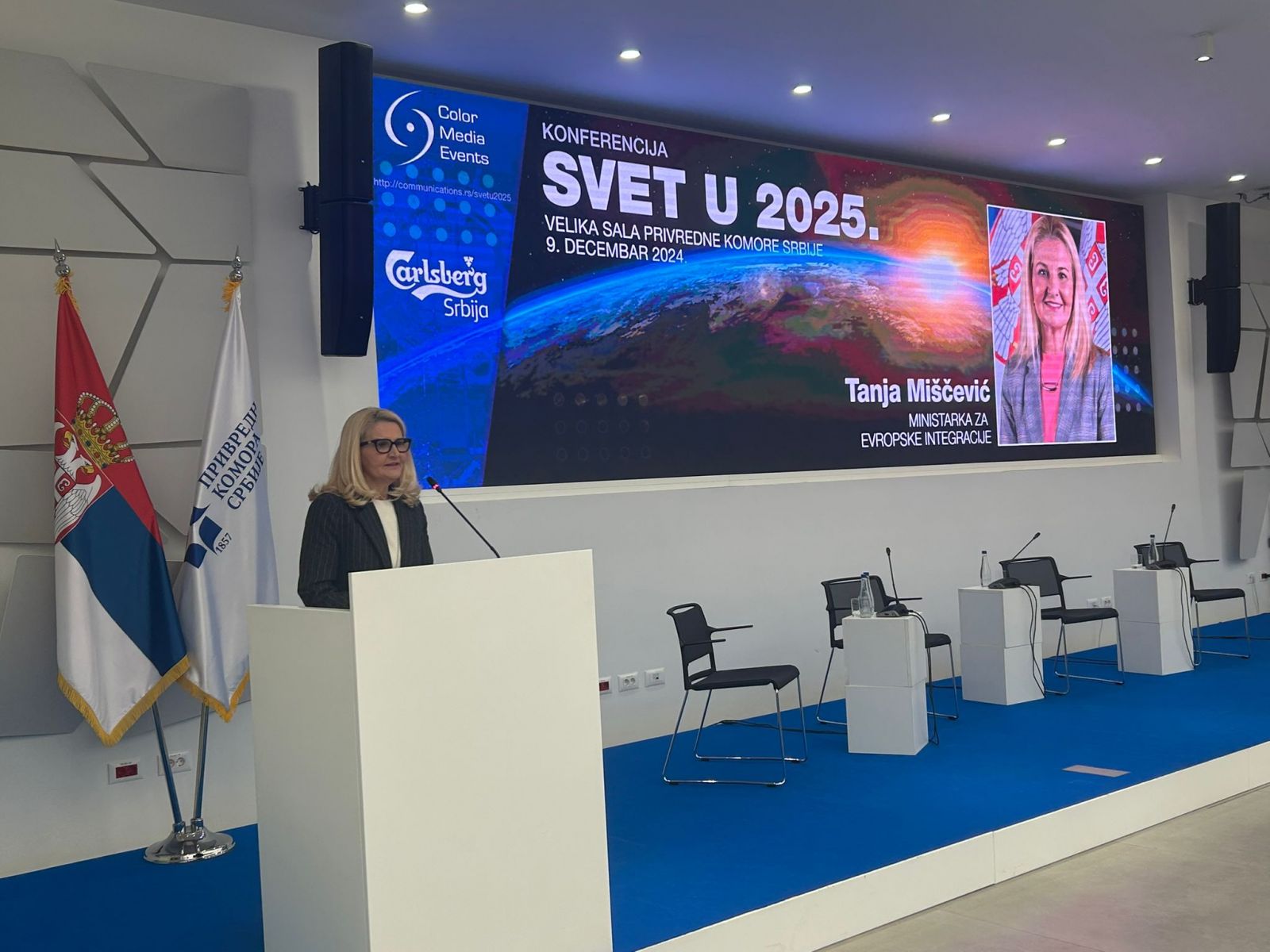
Minister of European Integration Tanja Miščević emphasised today at the “World in 2025” conference that Serbia was part of Europe and that the European Union was awaiting the start of work of new institutions after the elections. She highlighted the importance of that, stating that the following year would see the EU focusing on itself, i.e. its own reform, which also entailed the enlargement policy, “and that’s where we come in.”
“The enthusiasm for enlargement seen this year hasn’t been present for a long time,” Miščević noted and expressed hope that the momentum would continue into the following year.
Miščević said that the business community had asked the Government to expedite the establishment of green corridors and integration into the Single Euro Payments Area (SEPA).
“Serbia is demonstrating its credibility as a partner by implementing the Reform Agenda, which is not just a wish list but a set of commitments the state has made and is prepared to fulfil,” Miščević stressed, adding that 2025 could be viewed as a year of progress in negotiations.
“We are working on opening clusters and obtaining the green light for meeting interim benchmarks in the rule of law,” Miščević said.
Minister of Interior Ivica Dačić stated that expectations for the coming year represented “an equation with many unknowns,” but he and other ministers participating in the conference expressed confidence that Serbia could meet the challenges.
Dačić remarked that Serbia was on the right track and ready to utilise all its potential for the benefit of its citizens.
“I am convinced that in 2025, Serbia will continue to strengthen its position not only in the region but also globally,” Dačić said.
He assessed that the world in the coming year would be challenging but also full of opportunities. As the Minister of Interior, he assured that Serbia would be a country building a safe, stable, and fair society.
“The crisis is a constant; as long as I can remember, we have been in a crisis, and I do not know how we would function if we were not in one. The key is to know how to manage a crisis, not to run from it,” Dačić stated.
Representative of the Serbian Chamber of Commerce, Mihailo Vesović, said that the biggest issue in 2024 had been inflation, which was gradually returning to planned levels. He noted that growth had been around 3.8% and that Serbia had achieved an investment-grade credit rating.
He stated that growth of 4.5% was expected in 2025, acknowledging risks related to energy and food supplies as well as global challenges, but expressed cautious optimism among businesspeople regarding the coming year.
Minister of Information and Telecommunications Dejan Ristić said that 2024 had been a record year in terms of the economic aspect of telecommunications and that Serbia was a leader in information and communication technologies.
Ristić mentioned that broadband internet rollout would continue in 2025 and that the development of “Serbian Booking” would begin, adding that amendments to all three media laws would be completed by the end of the year.
He said that he was awaiting 2025 with apprehension, foreseeing a global crisis. As a historian, he described himself as a cautious pessimist but expressed hope that Serbia would manage to avoid these challenges.
Minister of Labour Nemanja Starović expressed confidence that the Ministry would successfully tackle challenges in the upcoming year and complete important processes in standardising new social protection services.
Minister of Sports Zoran Gajić stated that Serbia was recognised as a sports nation and emphasised the need for modernised education to meet the demands of new coaches.
Minister without portfolio Tatjana Macura remarked that Serbia aimed to create a society of equal opportunities, stressing the need to make more space for women in innovative industries related to modern technologies. Furthermore, Minister without portfolio Đorđe Milićević stated that Serbia was geographically oriented towards the EU, belonged to it, and had “belonged to the EU far more than some countries that are now members.”
UN Resident Coordinator in Serbia Matilde Mordt noted significant global changes – technological and geopolitical – shaping the future.
British Ambassador Edward Ferguson pointed out that the upcoming year would bring changes to the U.S. administration. He described the global geopolitical situation as fragile, predicting continued competition between the U.S. and China.
He said conflicts in Ukraine, Gaza, Sudan, and other regions would remain challenges in 2025, while climate change would continue to intensify, adding that the upcoming year was an election year for half of humanity.
The conference, as in 2014, was opened with a clip from the film “Casablanca.”
Source: Fonet


