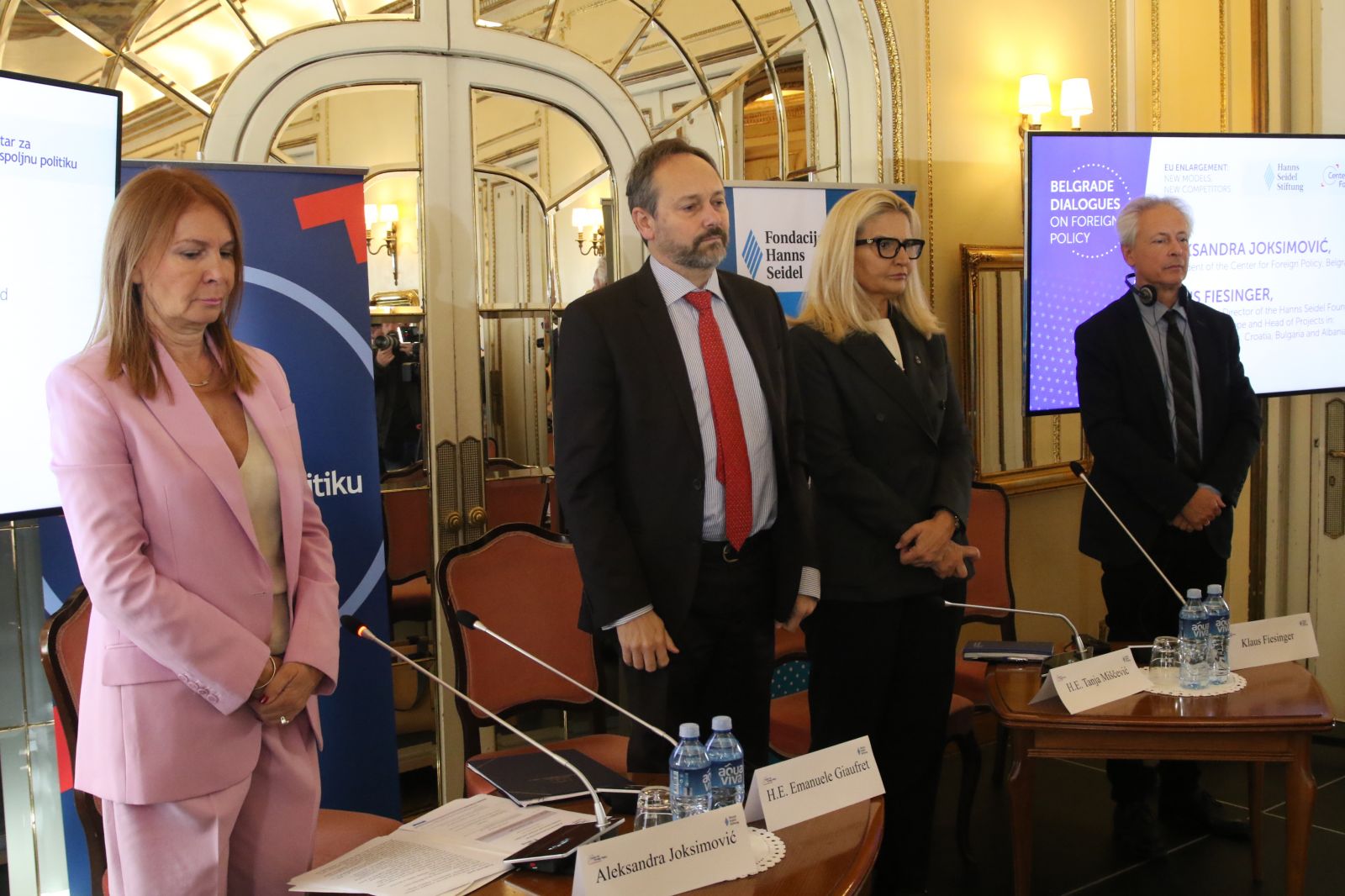
Minister of European Integration, Tanja Miščević, assessed today that the year 2027, by which Serbia might complete the reforms necessary for EU membership, was not “imaginary” – it is an assessment done together with the European Commission. She noted, however, that even after that, the work will not be finished.
After 2027, we will be expected to show a track record, namely our implementation track, then preparation of agreements to be ratified; hence, our work will not be finished even after 2027, Miščević said at the conference “Belgrade talks about foreign policy – Enlargement: New models, new players.”
The Government of Serbia adopted the National Programme for the Adoption of the Acquis, as a clear overview of all activities, as well as the Reform Agenda, she reminded, noting that the Agenda outlines 98 activities for which Serbia clearly indicated it was prepared to fulfil by a specific deadline and in a specific manner.
This is not a substitute for the negotiation process, she emphasised and added that the country should fulfil eight measures by the end of the year that arise from the Agenda, laws and strategic documents and which are part of the recommendations from the European Commission’s Progress Report on Serbia.
The most important thing for me is not assessments but recommendations because they accelerate our process. The other part of acceleration is the Growth Plan, namely inclusion in single market policies, the Minister said.
Tanja Miščević said that the Growth Plan implies EUR 6 billion, but there is also a “plus”, defined by the World Bank as remittances amounting to EUR 2 billion.
According to the Minister, acceleration of the accession process is also possible through a constructive approach in the dialogue on the normalisation of relations between Belgrade and Priština, while the alignment with the foreign and security policy of the EU must not be neglected either.
Our goal is not only to open cluster 3 as soon as possible but also to open other chapters in the remaining clusters and to discuss the fulfilment of interim benchmarks for chapters 23 and 24, Tanja Miščević concluded.
Head of the EU Delegation in Serbia, Emanuele Giaufret, estimated that Russian aggression against Ukraine set into motion the process of enlargement, but the process now included several new states in addition to the Western Balkan ones.
Giaufret pointed out that the mechanisms for financial support to the EU membership candidates were activated rather quickly.
According to him, intensive activities were ongoing to include the region in the single European market even before membership.
“The accession process and geopolitical context indicate that EU membership is a strategic choice,” Giaufret underlined.
This is an important choice, and we welcome the fact that Serbia confirmed EU membership as its strategic goal, which is an important step that we do not underestimate. We welcome everything that Serbia did to support Ukraine, the position it advocated in international fora, and we also appreciate its contribution to EU missions in Africa, Giaufret said.
Serbia’s alignment with foreign and security policy of the EU is at 51%, which is why it is important to be as clear as possible in determining Serbia’s direction if it strives for EU membership, he said.
President of the Center for Foreign Policy, Aleksandra Joksimović reminded that the EU enlargement process was blocked for a number of years, following the statement of former President of the European Commission Jean-Claude Juncker that there would be no enlargement in his commission’s mandate.
Enthusiasm was gone, and reforms were suspended. We got the Berlin Process as “fire keeper” in order to keep the process alive, she said.
According to her, the geopolitical situation was the unfortunate factor that brought the EU enlargement topic into focus.
Aleksandra Joksimović estimated that countries in the region must transform more quickly, the EU must show that it indeed wanted these countries in its membership, while actors must restore confidence among each other.
Regional Director of the Hanns Seidel Foundation, Klaus Fizinger, estimated that strengthening regional cooperation would contribute to accelerated European integration.
Fizinger assessed that the year 2022 brought on geopolitical changes that altered the enlargement process, which reflected positively on the Western Balkans.
On the other hand, that may bring an additional challenge for the region, he added, because new competitors from the Eastern Partnership appeared – Ukraine, Moldova and possibly Georgia, which may take the lead.
The conference started with a minute of silence for the victims of the accident at the train station in Novi Sad.
Source: FoNet


