
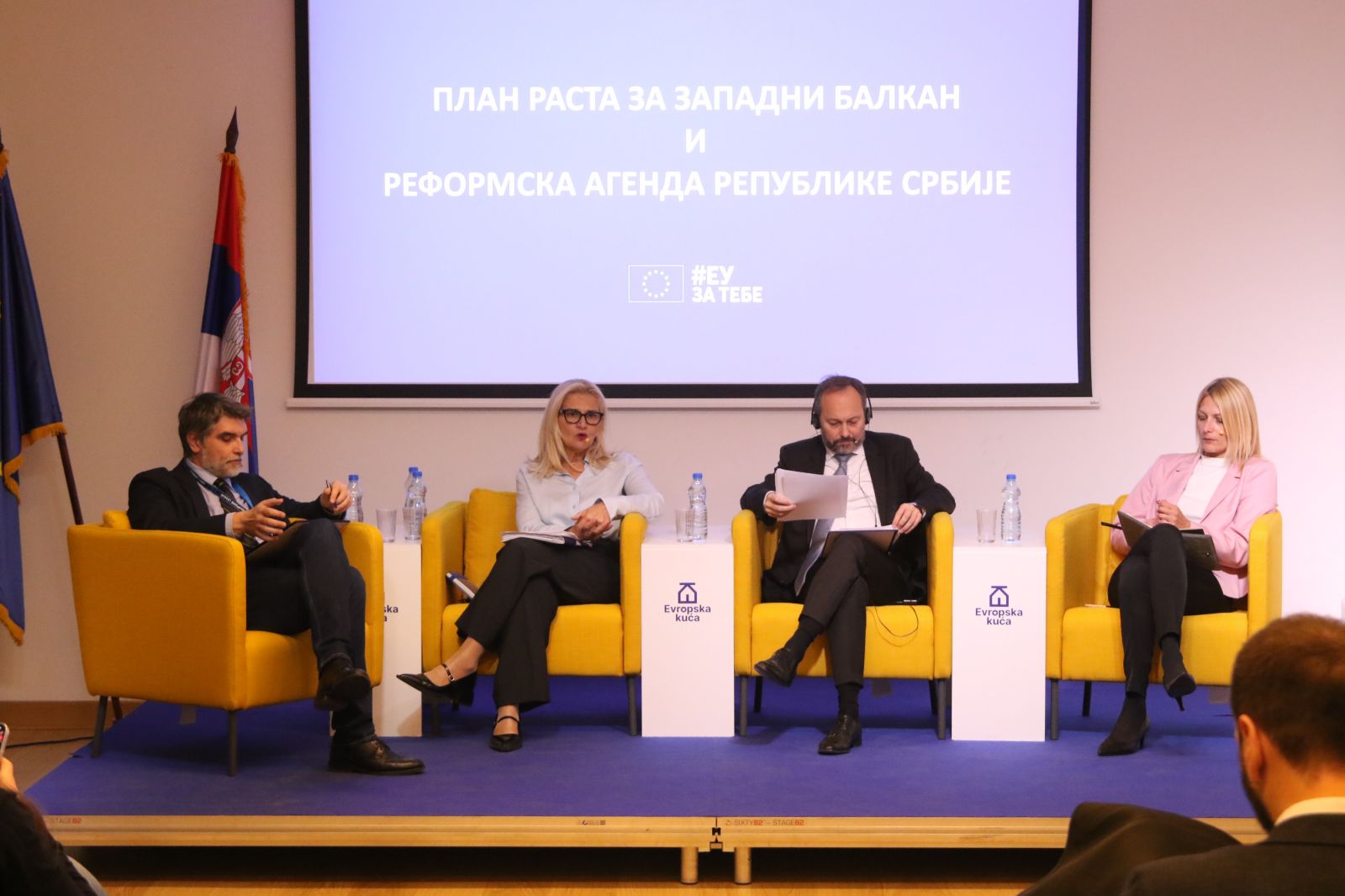
Minister of European Integration Tanja Miščević stated today that Serbia needed to fulfil seven specific measures by the end of the year to demonstrate its readiness to implement the Reform Agenda, including the application of ODIHR recommendations to improve the election process and the re-election of the REM Council.
“By the end of this year, the first priority of the Reform Agenda is the implementation of ODIHR recommendations, the election of the REM Council, the implementation of the Electricity Integration Package, the inventory of state aid schemes, and the adoption of by-laws related to the security of the 5G network,” Miščević said.
She emphasised that three laws also needed to be amended, clarifying that the laws on electronic media and public information and media should be amended and that the new Law on Public Media Services should be adopted.
“We need to adopt the Action Plan for the Anti-Corruption Strategy and further align with the EU visa regime for three additional countries whose citizens need visas to enter the Union,” she added.
“Only when the European Commission confirms that we have fulfilled all the measures can we receive funds from the first tranche,” Miščević said, noting that that was unrelated to so-called pre-financing.
“We do not have a membership accession date, but we have created a document that anticipates Serbia accepting the obligations of an EU Member State by mid-2027, which I believe speaks to the ambition of this agenda,” Miščević emphasised.
According to her, by implementing these measures, Serbia demonstrates that it is a credible partner in EU negotiations and accession.
Miščević said that a meeting with the National Convention on the EU (NCEU) would take place next week to discuss how they would be involved in monitoring the implementation of the Reform Agenda.
Head of the EU Delegation to Serbia Emanuele Giaufret said that, according to estimates, Serbia could count on up to EUR 1.58 billion from the Growth Plan, alongside IPA funding.
“This is an opportunity for Serbia and the region to close the economic gap that exists between them and the EU average, but also to experience some benefits before actual EU membership,” Giaufret explained.
“We want to accelerate the integration process, and this is evident from the speed at which the Growth Plan, legal bases, and budgeting were established within a single year, all amidst EU elections,” he reminded.
Giaufret pointed out that the financing differed from that of IPA and that the funds would be disbursed upon the completion of certain steps, similar to what the EU had done to its Member States during the COVID crisis.
“In terms of monitoring the reforms from the Agenda, we will also rely on civil society,” he announced.
“This will be an opportunity for the Serbian economy to realise its full potential, achieve green and digital transition and strengthen the rule of law concerning elections and media, all aimed at faster progress towards the EU and improving the quality of life for Serbian citizens,” Giaufret explained.
“The European Commission and the Serbian Government have worked hard to develop this agenda, and we hope that after the adoption of two laws in the National Assembly, pre-financing will be available by the end of the year,” Giaufret said.
NCEU Coordinator Bojana Selaković said that civil society was not entirely satisfied with how the Reform Agenda process had unfolded, as they believed it could have been more ambitious.
She mentioned that the NCEU and the relevant National Assembly committee had been informed of the Reform Agenda simultaneously and would monitor its implementation.
“We are not satisfied with the ambition of the proposed reforms and felt that this was an opportunity to speed them up,” Selaković added, expressing hope that the fulfilment of the measures from the Agenda would unblock the integration process, which had been at a standstill for three years.
Selaković remarked that that was a positive signal from the EU, indicating that the enlargement process had a definite end and that the EU wished to conclude it and integrate the Western Balkan countries.
On 3 October, the Serbian Government adopted the Reform Agenda, a document outlining a list of selected reform areas.
According to the European Commission’s methodology, pre-financing for Serbia is expected to amount to EUR 112 million, but before that, Serbia must agree with the EU and ratify financial instrument and loan agreements in the National Assembly.
Across the four reform areas, 98 measures are outlined, which must be met for Serbia to receive EUR 1.58 billion by 2027 from the Western Balkans Growth Plan in the form of grants and loans.
In the area of Business Environment and Private Sector Development, 26 steps are required for the disbursement of funds; in the area of Green and Digital Transition, 39 steps; Human Capital requires the completion of 12 steps, and 21 steps are necessary for the Rule of Law area.
There is also a specific condition for Belgrade and Priština, requiring a constructive approach to the dialogue taking place under the auspices of the EU.
Source: FoNet


