
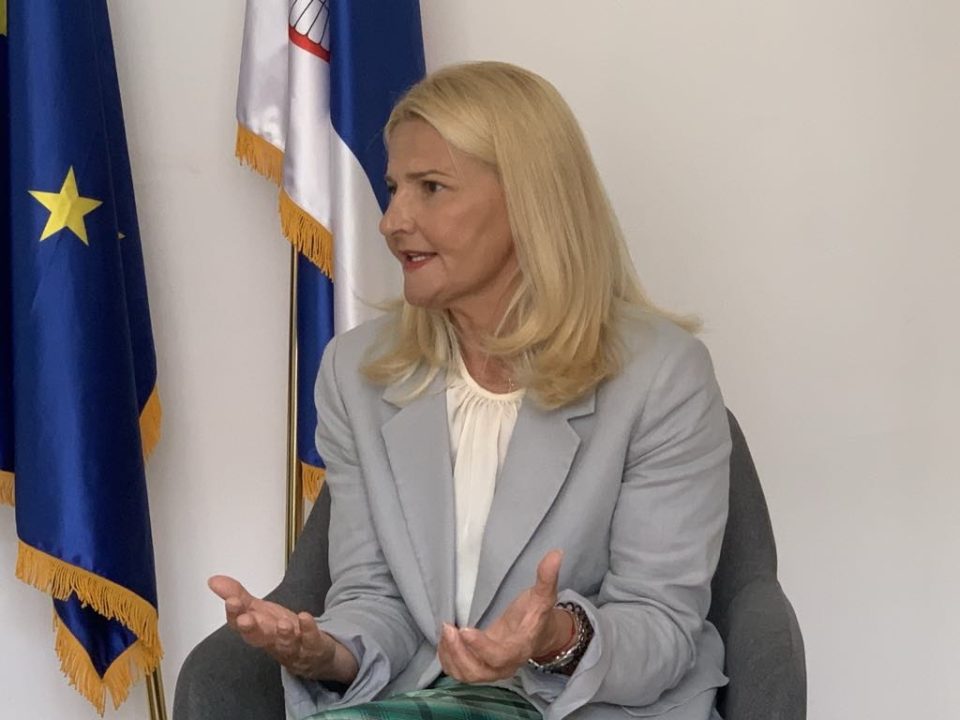
Minister Tanja Miščević interviewed for European Western Balkans
The last time that the European Union made progress with Serbia in the area of European integration was in December 2021, when the Negotiation Cluster 4 was opened. Although Serbia has been technically ready to open Cluster 3 (Competitiveness and inclusive growth) for a long time, there has not yet been the political will among Member States to organise an Intergovernmental Conference and to move forward.
The implementation of reforms defined with the purpose to withdraw funds from the Growth Plan for the Western Balkans will be a new test of Serbia’s serious commitment to its European path.
The Growth Plan and its importance for Serbian citizens, the European integration process, and key challenges on that path were the topics of our conversation with Tanja Miščević, Minister of European Integration in the Government of the Republic of Serbia.
The first tranches from the Growth Plan for the Western Balkans may be expected by the end of the year. What kind of benefits can Serbian citizens expect from the Growth Plan for the Western Balkans?
Pre-financing is expected as early as the end of September. In accordance with the Regulation on this new financial instrument, pre-financing entails 7% of the total amount for each state prior to the beginning of the fulfilment of all liabilities. By the end of the year, the first “real” tranche should arrive, i.e., one that must be preceded by the fulfilment of indicators.
In our Reform Agenda, we have listed several very interesting indicators which we need to fulfil by the end of 2024. For instance, the establishment and activities of the Working Group on the fulfilment of ODIHR recommendations, as well as further alignment of Serbia’s visa policy with the EU and amendments to media laws. I would say that there are some very serious obligations which we will have to fulfil so the funds finally arrive as the first tranche.
What are the benefits for the citizens? First of all, it is about adhering to a general principle which has been established, which is that funds will be provided once we have implemented the reforms, and these reforms, some of which I have mentioned, are in the interests of citizens.
In addition, the second part of the Growth Plan – accelerated integration into the EU Single Market – will generate further growth, providing benefits to citizens. We will submit an application for access to the Single Euro Payments Area (SEPA) no later than the end of this year, which will also entail large savings for all of us. When we are a part of this area, we will save at least 10% of each transaction we have in euros.
This will bring large benefits to both legal entities and individuals in Serbia, as well as in the region. According to the World Bank, the region loses half a billion EUR per year on the transfer costs for these transactions from European banks to our banks. These are just a couple of examples that show that the value that citizens gain from the Growth Plan may be much higher than the six billion that have been allocated as financial assistance for Western Balkans.
In addition to the reforms that are included in the Reform Agenda, additional conditions concern the rule of law, alignment with the EU foreign policy, as well as the dialogue with Priština. These are also the largest difficulties of the accession process. Could these conditions present a challenge for Serbia in withdrawing all the funds that have been made available to us?
I would like to clarify some things. There are general conditions such as the rule of law, which is the primary condition for any kind of dialogue with the European Union, any kind of arrangement, not only as a candidate country in membership negotiations. This condition also applies to those countries entering only into trade agreements with the EU. This is also a condition in this case.
It is true that there is also a precondition specific to both Belgrade and Priština, which entails a constructive approach to the dialogue between Belgrade and Priština. We have been constructive in our approach to continuing the dialogue, demonstrating that we would like to discuss the implementation of all the agreements reached, of course, from what was agreed back in 2014 to the present day.
When it comes to the alignment with the Common Foreign and Security Policy, that is a goal to strive for rather than a precondition. However, we know that alignment is one of the very important measures, and that the Growth Plan and the Reform Agenda should help improve this alignment.
Everything is a challenge, as nothing is guaranteed. Money is a sign of the EU’s goodwill to accelerate the process and to help us in our reform efforts by providing additional funds for the reforms. However, it is fully up to us to fulfil the obligations that we have said we are able to fulfil. To strive towards EU membership that we are strongly committed to after a long period when the enlargement fatigue shaped the actions of the European Union, as well as ours. Now, we all must engage in the improvement of this process, starting with the rule of law.
You’ve mentioned the Reform Agenda. When will it be adopted?
Our idea was to adopt the Reform Agenda by 10 August, which overlaps with the 100 days of this Government. We have made all the necessary preparations, but the European Commission has not yet completed its consultations among the competent directorates, so we will wait a few more days.
Before the adoption, we also held consultations with representatives of the National Convention on the European Union and the members of the European Integrations Committee of the National Assembly. We have sorted all of their comments about elements of the Reform Agenda that we have received by area and sent them to the competent ministries and bodies in the Government so they can familiarise themselves with them. We want to see how we can include those comments, as we have taken seriously all that was said during the four-hour discussion, as well as the things that we have received from civil society organisations in writing.
I must say that these comments will certainly be an important segment of the implementation of all indicators, since they will serve as a kind of guide for us to achieve the planned goals. In addition, civil society will be included in the monitoring of the implementation and in the communication on this topic. It is important for us that this dialogue be established from the start.
I know that there are objections to the non-transparency of the completion of the Reform Agenda. But I would like to remind you that we sent a request to the European Commission immediately after the Growth Plan was presented that we start with the communication, as we will not have enough time to do it at the end. However, the path was different.
I would like to remind you that the Director-General of the EC’s Directorate-General of the Neighbourhood and Enlargement Negotiations Gert Jan Koopman held a regional dialogue on the topic of the Growth Plan in December. We then moved on to the national level. We first organised a talk with the National Convention on the European Union in March, addressing four chosen strategic areas, with coordinators for each of them. Afterwards, meetings were held with the business community, and some civil society organisations organised discussions in certain areas, such as those we had on improving the business environment and digital and green transitions.
I accept the criticism that we could have been more transparent, but I must say that, due to the complexity of the work involved in implementing everything related to the Growth Plan in relatively short timeframes, it was not possible to do it differently. Nevertheless, what we have learned from all of this is that it is crucial to conduct dialogue in the next phases – reporting, monitoring and communication – and we will discuss how the National Convention should be involved in these segments. We will wait to see what representatives of the civil society will have to say about it all.
Hungary is currently presiding over the European Union. You have, just like other state officials, reiterated multiple times that you expect progress during Hungary’s presidency. What has changed from the previous period when it comes to reforms? What does the Serbian Government’s argumentation for moving forward in the negotiations look like?
Our argumentation is that the accession process must be merit-based. I will remind you that the European Commission told Serbia last October, for the third time, that it fully meets the requirements for opening Cluster 3 (Competitiveness and inclusive growth). In the talks in Brussels and the capitals of the Member States, we heard that all the conditions for opening this Cluster exist. We also heard from the European Commission that our Reform Agenda is very ambitious, as we plan to meet even some of the benchmarks for closing certain chapters by the end of 2027.
All this means that we are determined to move much faster and to improve the process as a whole, since we understand that there is momentum. Unfortunately, the Cluster was not opened because of the Western Balkans, but due to the war in Ukraine, for the purpose of a closer connection with the EU, and so the EU would show solidarity, which we share here in Serbia. Regardless of the fact that our region is not the reason why the momentum exists, we wish to accept and use it.
Of course, there are also conditions which are not just about the fulfilment of technical standards. Those are primarily the conditions concerning the dialogue between Belgrade and Priština, which is an unusual segment in the process, as well as the matter of alignment with the CFSP, which is also one of the elements measured during an assessment whether a state may make progress in the process, i.e. open clusters and close chapters. This alignment with the new geopolitical moment has become crucial, and this is a new challenge.
We are trying to explain that our alignment with the Common Foreign and Security Policy and the EU defence policy is about much more than just an alignment percentage. This also applies to other matters, such as the non-avoidance of sanctions, and Serbia is an excellent positive example in that regard. Experts from the European Commission who are in charge of that are saying that Serbia is also the most reliable partner in the EU peacekeeping missions. Our country is the first that will be able to have a civilian mission included in the European Union missions. Let me remind you that we have been unambiguously supporting the territorial sovereignty of Ukraine from the start and that we have been helping them in various ways, both by supplying equipment and humanitarian aid and by assisting them in the European integration process.
This is what we are building our arguments around, and this is what we are trying to convince the other side. We wish to take advantage of Hungary’s presidency of the EU Council, which prioritises further enlargement and, in particular, balance regarding the Western Balkans.
The European Commission has published the Rule of Law Report for Serbia, which was, for the first time, compiled according to the same methodology as for the Member States. Are you satisfied with the findings?
We can never be satisfied with the findings as regards the rule of law, as this is an area where we can never say that we have achieved everything. For instance, the judicial reform is not a process which ends with EU membership, and there is always room to improve and learn from the experiences of others.
This first Report for Serbia and a review for all other countries has also been translated into Serbian and published on the website of the Ministry of European Integration and it can be read by all interested persons.
When you compare the summary findings of the Report, you will see that there are several key topics that are also being discussed in the EU, such as the fight against corruption, media and the role of judges and prosecutors in appointments to high-level judicial and prosecutor positions. These are also our topics. In these segments, we are involved in a serious reform process.
Let me remind you that, after the constitutional amendments, we are now in the phase of implementing judicial laws so that judges and prosecutors take part in the appointment of judges and prosecutors. Last year, we adopted three media laws, and we are working on amending them. We have launched a debate on them ourselves, as we have ascertained that some things are not fully aligned with the EU law. Of course, it is very important that, at the previous session of the Government, a new Anti-Corruption Strategy was adopted, which puts an emphasis on prevention.
For that reason, we are reading the Report thoroughly, and we are ready to work on those matters which are key for strengthening the rule of law and for the EU.
We have mentioned multiple times that the alignment percentage will increase as regards the alignment of national legislation with EU legislation. What is happening with the Report on the implementation of the NPAA?
We are working on an amendment to the electronic system, which is our main tool in the development of the NPAA, as it has not responded to our needs and requests in the best manner possible. We had planned to have a new NPAA by the end of July, but we had to extend the deadline to the end of August.
It is very important to us to also have an alert system that would indicate that we are late in certain areas before the expiry of the deadline for which we had said that it would be met. The Ministry of European Integration is currently informing the Government semi-annually, followed by the Assembly and then, of course, the public, on the fulfilment of the plan, which was 33% last year. If we are ready to accelerate the accession process, and this is what we want, we must also speed up the process of adoption and harmonisation of European legislation.
After the signing of the Memorandum of Understanding between the EU and Serbia on the strategic partnership on sustainable raw materials, battery production chains and electric vehicles, European and Serbian official said that this could accelerate Serbia’s European path. In what way could cooperation in these areas accelerate the negotiations, in view of the fact that these matters are not a part of the negotiation process?
There are several important things to specify here. The Memorandum of Cooperation has been signed, which means that you can see the possibility of cooperation, in this case between Serbia and the European Union, and not concerning lithium, but what is called the electric vehicles production chain.
Where is the root of this cooperation? Its root was presented back in October last year when the new Growth Plan for Western Balkans was presented. This is the reason why Commissioner Maroš Šefčović, as well as the President and the Prime Minister, are insisting that this will accelerate European integration since this is what the European Commission sees during the communication on the Growth Plan.
I would like to remind you that the Growth Plan has four pillars, and the first one concerns accelerated integration into the Single market. As a region, we have been aligning our standards with the EU standards for over 20 years, but we don’t know when we will become an EU member. However, it is obvious that the European Union has noticed that there is room for us to become involved in some of the common EU policies much faster, precisely due to the achieved level of alignment.
For that reason, the European Union has defined seven areas in which the accession of a country from the Western Balkans into the single EU market may be accelerated. The area best known to the public is Green Corridors, as well as the accession into the single payment area. However, one of these areas is inclusion in what is known as a critical materials production chain. Let me remind you of this, too – on the EU market, you can only find goods that satisfy the conditions and standards of the European Union, which have an “acceptable” carbon footprint, and are produced in accordance with environmental standards. For that reason, the European Union is the guarantor of the protection of standards and quality of all goods, including these raw materials.
What are the priorities of the Ministry of European Integration in the upcoming period?
One of the priorities we are working on is the creation of a very good and solid model for monitoring coordination in the implementation of the Reform Agenda since this is now our new mode of control of the seriousness in the negotiation process. Another priority is the improvement of communication of the Reform Agenda implementation process. Opening new clusters is also very important to us, and not only Cluster 3, which has been ready for a long time. We are also preparing to open another cluster by the end of this year.
Another priority is the Interim Benchmark Assessment Report (IBAR), i.e. the assessment of the fulfilment of interim benchmarks for Chapters 23 and 24, so that by the end of this year, we would have a very clear and open debate on this topic with our colleagues from civil society. The dialogue is one of the priorities that I see as crucial in the European integration process.
So when can we expect IBAR?
We are still at the beginning. We have completed the self-assessment, and last week, we received an evaluation of our self-assessment from the European Commission. Our task now is to review and analyse the comments we received and subsequently sit and talk to civil society. I would like to highlight the fact that it is not the Ministry of European Integration but more than 50 institutions of the Government of Serbia, including independent and regulatory bodies, which are coordinated very well and efficiently by our colleagues from the Ministry of Justice and the Ministry of Interior.
One of the reasons for my recent visit to Podgorica was to agree on a meeting of the two teams with their Minister of European Affairs, Ms Gorčević, to discuss IBAR. We wish to hear which steps and processes they had to undertake to get the opportunity to start fulfilling the closing benchmarks for the rule of law chapters.
The timing and date and how quickly it will happen is much less important than how we can reach IBAR so that it really has its full power. The assessment of the fulfilment of interim benchmarks is a key point of the transition to a new negotiation phase, as it means we can talk about closing negotiation chapters.
Source: EWB
Photo: ЕWB / Marija Stojanović


