
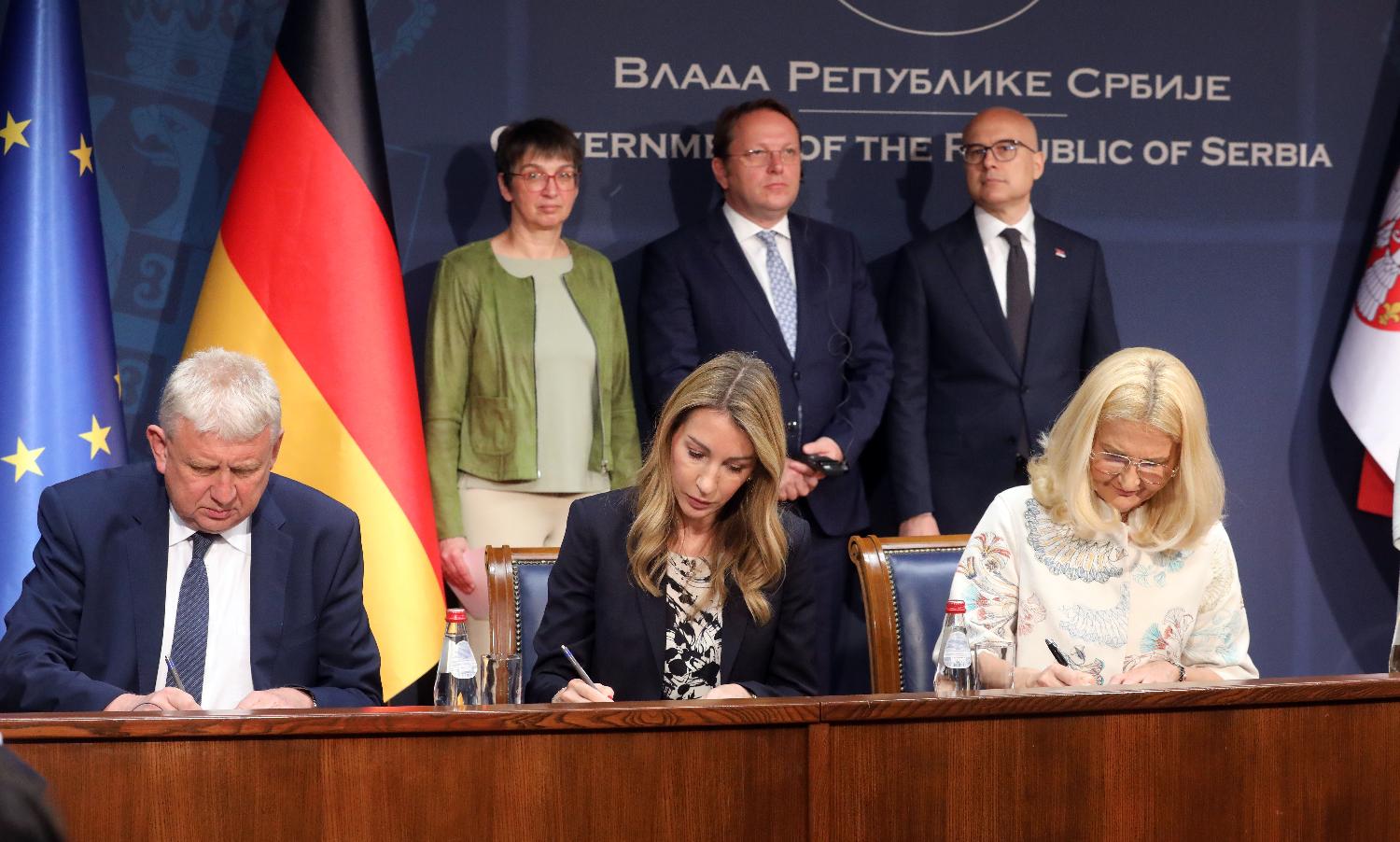
The European Union provided EUR 10 million in grants to support the second phase of the “Renewable Energy Sources – Development of the Biomass Market in the Republic of Serbia” programme. The project will enable heating plants in several local self-governments to transition to using biomass as fuel, providing residents with a secure energy supply and a healthier environment.
In the presence of Serbian Prime Minister Miloš Vučević, European Commissioner for Neighbourhood and Enlargement Olivér Várhelyi, and German Ambassador to Serbia Anke Konrad, the grant agreements were signed by Minister of Mining and Energy Dubravka Đedović Handanović, Minister of European Integration Tanja Miščević, and Director of the KfW German Development Bank office in Belgrade Carsten Sandhop.
The total project value is EUR 31.9 million, with the remaining funds being provided through a loan from the KfW German Development Bank and donations from the Federal Republic of Germany.
“In the previous phase of the project, we built four biomass heating plants in Priboj, Mali Zvornik, Novi Pazar, and Majdanpek, with a total investment of EUR 27 million. This investment has provided citizens with reliable and quality heating and cleaner air. With the support of the EU and Germany, we will continue these investments in Niš, Bajina Bašta, Prijepolje, Rača, and Novi Pazar, where we plan to replace fuel oil and coal with biomass. Carbon dioxide emissions will be reduced by 88%, and sulfur dioxide emissions will be almost completely eliminated, providing citizens with a healthier environment,” said Minister of Mining and Energy Dubravka Đedović Handanović.
She thanked the European Union and German partners, traditionally among the largest donors to the energy sector in Serbia, and emphasised that more than one-third of the funds for the second phase of the project with KfW were provided through donations.
Commissioner Várhelyi stated that new investments in district heating would continue to reduce air pollution while promoting local development and economic growth, as wood biomass must be sourced locally to be economically sustainable. “With the signed grant agreements worth EUR 10 million, the EU supports investments in cleaner air and safer energy supply, reiterating the principles of green transition by fostering energy independence and environmental responsibility,” said Várhelyi, recalling that in the past ten years, the EU had provided more than EUR 600 million in grants to Serbia’s energy sector.
Minister of European Integration Tanja Miščević stated that the project was important for energy diversification and transitioning to new energy sources, primarily biomass.
“This project has so far demonstrated sustainability and benefits for citizens; in the first phase, we had four new heating plants, and now we are entering the second phase with interest from several more municipalities. This significantly improves the environment in which our citizens live, reducing sulfur dioxide and carbon dioxide emissions. All these are elements of the energy transition and our alignment in the field of environmental protection covered by Chapter 27, as well as the obligations we have undertaken from the Green Deal and other regional initiatives,” said the Minister.
The Minister thanked the European Union and Commissioner Várhelyi for their understanding of the need for infrastructure project development, including those in the energy sector in Serbia and the region. She especially thanked the Federal Republic of Germany for its significant bilateral support and assistance to Serbia and expressed confidence that cooperation in this direction would continue.
German Ambassador to Serbia Anke Konrad emphasised that international climate goals could not be achieved without the Western Balkans.
“Through its strategic climate partnership with the Western Balkan countries, Germany will continue to support Serbia in implementing an ambitious energy transition process. In the case of Serbia, sustainable use of biomass should facilitate the energy transition and contribute to achieving climate goals. Citizens in local self-governments where biomass heating plants have been built have already experienced the benefits of the first phase of the project. We are very pleased to continue promoting an energy sector that will enable a secure supply in a sustainable manner, as additional technical assistance will be provided to establish sustainable forest resource management,” said Konrad.
Source: Ministry of Mining and Energy
Photo: FoNet


